




ADMITTING
The hardest truth is the first one. These three steps are about stopping the lies — to yourself, about yourself.
- Gambling controls you
- Believe help is possible
- Let go. You're not in charge
You can get anonymous help for gambling addiction.
With Gamblers Anonymous behind you.
Free. Private. Here for you today.
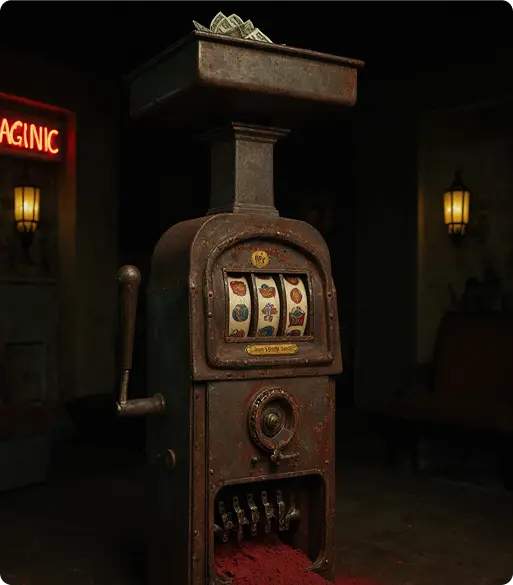
Psychologists and researchers call them "the crack cocaine of gambling" — not for shock value, but because slots are designed so your brain cannot stop.
Global research shows:
They take your time. Your relationships. Your health. Your future.
If you recognize yourself
in
these lines — you are not weak. You are not "someone who can't stop." You are facing a product
engineered to trap you.
Thousands of people have already regained control of their lives
through Gamblers Anonymous.
The first step is admitting the problem.
The second step is
today.
Slots look like harmless entertainment. In reality, they are one of the deadliest forms of gambling — because they are engineered to drain your money fast and without you noticing.
The moment you switch to real money, the game stops being a game. It becomes a siphoning machine. Here is what actually happens.
One spin takes 3–4 seconds. You can burn through an entire day's wages in just 10 minutes. The average online slot player loses $300–$600 every hour. By the time you feel it, it's already gone.
Slots wire your brain for addiction 3 to 4 times faster than poker, sports betting, or lotteries. That's why 75% of people with severe gambling problems say slots are their main destroyer.
Debt. Loans. Lost jobs. Broken marriages. Depression. Suicidal thoughts.According to WHO and ICRG, a problem slot player loses $20,000–$50,000 per year on average. One in five seeks help already drowning in unpayable debt.
Your phone is in your hand. You're sitting in a soft chair. Bright colors flash. Winning sounds play. Your brain swims in dopamine.Meanwhile, your wallet empties in silence.
Slots don't just take your money. They take your time, your relationships, your health, and your future. And they do it so gently that you don't even notice.
Let's be honest. Quitting "right now and forever" doesn't always work. The urge can be
overwhelming. Your brain is screaming for its usual dose of dopamine.
In moments like
this, social slots — free slot simulators without real money or bets — can act as a safe
bridge
toward recovery.
Think of it as a stepping stone. Not a solution forever. But a safer option for today — while you learn to take back control.
A 2021 study by Hollingshead and colleagues found something important.
People with
gambling
problems who turned to social casinos specifically to calm their urge to bet with real money
reported a noticeable drop in real gambling after just one month.
Here's the key detail: Among those who started with free slots — not the other way around — the goal of "reducing the craving" actually worked. They spent less time and less real money on gambling.
According to the study, about 17–28% of players already struggling with addiction see social slots as a form of harm reduction. It satisfies the urge. It provides the ritual. But there is no risk of losing rent money, paychecks, or savings.
Most people don't notice when gambling starts taking over. It happens slowly. Quietly. One
spin
at a time.
This quick, anonymous self-check will help you see your situation clearly — without
judgment,
without pressure.
Instructions: Answer honestly. Choose one option for each question. The test is anonymous.
0–2 Low risk. Stay aware. Slots trap slowly.
3–5 Moderate risk. Try a 7-day break.
6–8 High risk. Time to seek help.
9–12 Critical risk. Help is available now.
Gamblers Anonymous (GA) is a twelve-step fellowship created specifically for people who want to break free from compulsive gambling.
It started in 1957 in Los Angeles, founded by two gamblers who had lost everything — and found a way out together. The program follows the same proven model as Alcoholics Anonymous, built on shared experience, honesty, and spiritual principles — without any religious pressure.
The heart of the program is simple:
You are not weak. You are not broken. You are facing something designed to trap you — and there is a way out.
Thousands of people have already walked through the doors of GA. They came with nothing. They found everything: their lives back.
The hardest truth is the first one. These three steps are about stopping the lies — to yourself, about yourself.
No more excuses. No more hiding. These steps are about looking in the mirror — and telling the truth about what you see.
Gambling didn't just hurt you. It hurt people around you. These steps are about cleaning up the damage — not with words, but with actions.
Recovery is not a destination. It's a daily practice. These two steps keep you free — by staying honest and by lifting someone else.
We provide honest, caring information to help you understand the real harm of gambling.
No. All educational materials, self-tests, and resources on this website are completely free.
We don't track names, emails, IP addresses, or personal data. No registration.
Just open the site and use it. No passwords. No "sign up to read more."
We do not replace therapists, doctors, or professional counselors. If you need clinical care, we can point you to licensed professionals.
Choose the meeting format that's most convenient for you—in person, online, or by phone.
Get help
This website provides educational information only. We are not a casino, betting platform, or
crisis
service.
We collect no personal data. No names. No tracking. Your privacy is fully protected.
Recovery resources and helplines are shared for support. Use this information at your own
discretion.


